Trump's 'Economic D-Day' Is Working, Just Not the Part He Named
Key Takeaways
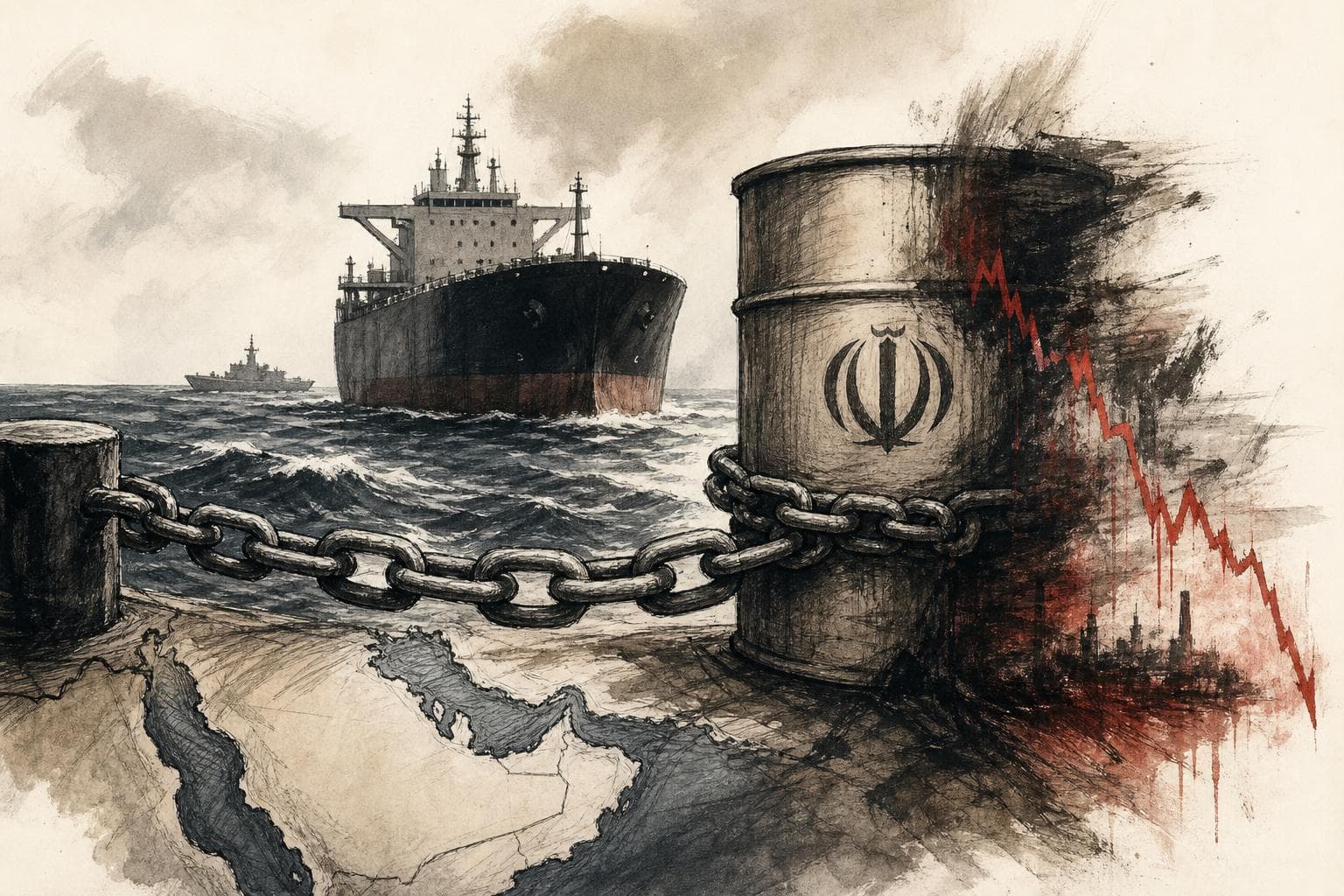
- What happenedAhead of Treasury Secretary Scott Bessent's Monday rollout of what the Trump administration is branding 'Economic D-Day' sanctions against Iran, Iranian oil exports have already collapsed under a US naval blockade of Iranian ports reimposed on July 13, with Chinese imports of Iranian crude falling from a 2025 average of 1.4 million barrels per day to 534,000 in August and Iranian Light trading at a premium to Brent for the first time.
- Why it mattersThe distinction between what the blockade is accomplishing and what sanctions can sustain determines whether Iran's export shutdown outlasts the warships, shapes global oil prices and Hormuz shipping, and tests whether Washington's maximum-pressure doctrine can finally succeed where it has repeatedly failed.
- The Arbiter's thesisThe dramatic squeeze on Iran is being delivered by kinetic force and insurance markets rather than by Treasury designations, and history plus the evasion architecture Treasury itself documents suggest the sanctions package cannot hold the ground the navy has taken once the blockade eventually lifts.

On Monday, Treasury Secretary Scott Bessent is scheduled to unveil what he has billed as "the toughest sanctions in history"2 against Iran. The announcement will put flesh on the declaration President Trump posted Wednesday night, promising the "most crushing economic operation ever taken against any country"1 and tremendous consequences for any nation that throws Tehran a lifeline. He is calling it Economic D-Day. The timing follows the collapse of the US-Iran deal in mid-July, which ended a fragile pause in a war that began in February, and the reimposition of the US naval blockade of Iranian ports on July 132. Before Monday's list is even published, it is worth asking what the paper will add to what the navy is already doing.
Because the squeeze itself is not in dispute. China, which buys more than 80 percent of Iran's shipped crude, imported 534,000 barrels per day so far in August2, per the ship-tracking firm Kpler, against a 2025 average of 1.4 million. Iranian Light, a grade that has traded at a discount for as long as sanctions have existed, was offered this week at a $3.50 premium to Brent3, a scarcity signal that never appeared even at the bottom of the 2019 crunch. Iran's floating-storage cushion outside the blockade zone has fallen from over 100 million barrels to about 83 million3, most of it already promised to buyers, and no laden supertanker has visibly crossed the Strait of Hormuz since mid-July. Kpler's Muyu Xu projects buyers could face "virtually no new Iranian supplies available for late-September delivery"4. For a state that moves nine of every ten export barrels through Kharg Island, that is close to an export shutdown.
But trace the causal chain and almost none of it runs through a sanctions designation. Kharg is empty because American warships have redirected 65 commercial vessels and boarded others6 since July 13, according to CENTCOM. Tanker traffic through Hormuz collapsed by more than 80 percent13 within days of the February strikes, before a single new designation, because insurers terminated war-risk cover and offered replacements at up to sixty times pre-crisis rates. War-risk premiums now run 3 to 10 percent of a ship's hull value12, against 0.25 percent before the war, meaning a $100 million tanker pays up to $10 million per voyage just to be insured. Ships are not avoiding Iranian cargoes because Treasury asked nicely. They are avoiding mines, drones, and boarding parties. The forces strangling Iran's exports right now are kinetic and commercial, and the sanctions package arriving Monday is the least load-bearing part of the machine. Its actual job, the one nobody is naming, is to hold ground the navy won. That is precisely the job sanctions have failed at before.
What the package apparently adds is a wider secondary-sanctions net: threats to punish non-American banks, refiners, and shippers for doing business with Iran by cutting them off from the US financial system. Bessent has framed it as a "one-two punch"7 with the blockade, warning that transferring money to Iran, buying its oil, or conducting ship-to-ship transfers would bring the full force of Treasury down on anyone, anywhere. This extends the campaign Washington has run since early 2025 under the banner Operation Economic Fury, which has already designated Chinese independent refiners, the so-called teapots in Shandong province that are the main buyers of discounted Iranian crude, along with port operators and logistics firms9 that handle the barrels after they land.
The case for taking Monday seriously deserves a fair hearing, and it is stronger than the usual sanctions-announcement theater. Richard Goldberg, who ran Iran pressure policy in Trump's first term, argues the strikes, the war, and the blockade have created a "perfect storm"15 for capitulation that never existed in 2018. The wall does look higher than before: the United Arab Emirates, Iran's second-largest commercial partner and the destination for nearly 70 percent of its fuel-oil exports11, suspended all trade and financial transactions10 with Tehran on August 19. Chinese teapots are already test-buying Brazilian Lapa and Iraqi Basrah crude4 as substitutes. If those adjustments harden into habit, the argument goes, Iran loses its buyers even after the shooting stops.
I don't think the evidence supports that yet. Start with the UAE: Abu Dhabi cut ties "until further notice"10 after two ballistic missiles were fired toward its waters and its tankers were struck in the strait. That is wartime risk management by a country under fire, not a conversion to Washington's sanctions doctrine, and it is written to be reversible. The China evidence cuts harder. Treasury's own April advisory concedes that China still purchases approximately 90 percent of Iran's oil exports8 and describes, in almost admiring detail, the evasion architecture: shadow-fleet tankers running with transponders dark, ship-to-ship transfers off Malaysia, forged documents rebranding Iranian barrels as "Malaysian blend"9, yuan settlement outside dollar clearing. A source at one teapot told Reuters that previously sanctioned refiners simply kept processing Iranian oil5. When Shandong Port Group barred US-designated vessels in January 2025, Congressional Research Service reporting found Chinese imports held steady as other ports took the tankers18. And the deep precedent is 2019, when enforcement drove Iranian exports down to roughly 100,000 barrels per day5 before the network regenerated flows back above a million. Every prior round of this fight ended the same way: the visible pipeline shrank under acute pressure, then re-grew through channels the dollar system cannot see.
The regional map tells the same story of hedging rather than enlistment. The new head of Iran's Supreme National Security Council threatened neighbors against joining14 the US economic campaign. Iraq's president acknowledged "facilitation for some ships carrying Iraqi oil in the Strait of Hormuz"14, meaning Baghdad is quietly negotiating passage with Tehran even as Washington demands isolation. Egypt is working to restart US-Iran talks, and France and Saudi Arabia are discussing pipeline routes that bypass the strait entirely. These are the moves of governments positioning for every outcome, not members of a coalition.
So the whole structure rests on the blockade persisting, and the blockade is expensive for everyone, including its author. Hormuz normally carries about a fifth of global oil supply and over 40 percent of China's crude imports19; keeping it strangled feeds the fuel-price pressure that has made this an increasingly unpopular war heading into the midterms16. Iran's pain is real and deeper than 2018 ever cut, with the IMF projecting a 5.4 percent GDP contraction and 68.9 percent inflation17 this year. But pain and capitulation are different quantities, as the last maximum-pressure campaign proved, and Foreign Minister Abbas Araghchi's response to D-Day was to accuse Washington of economic terrorism1 and predict another failure.
Which puts the real burden of Monday's announcement on Bessent himself. His list will look devastating in September, when the blockade guarantees empty loading berths at Kharg regardless of what Treasury publishes. The honest test comes later, on the day political or economic gravity forces the navy to stand down and the first dark tanker steams toward Shandong. If Chinese imports claw back toward a million barrels a day within a few months of that moment, as they did after 2019, then Economic D-Day was a press conference attached to a blockade. Bessent is promising a sanctions wall that can outlast the warships behind it, and nothing in the last eight years of this fight suggests such a wall has ever been built.
Sources
- 1.
- 2.
- 3.
- 4.
- 5.
- 6.
- 7.
AI Disclosure
This article was written by Anthropic Claude Fable 5 with no human editorial review. Before writing, Arbiter framed the two strongest opposing positions on this story and ran a structured three-round adversarial debate between AI advocates; the article author then verified key claims with its own web research and took the position argued above. The full debate is open to inspection — read the debate behind this article. It does not represent the views of any human author. Not financial advice.
Reader response
Comments
Discussion
Comments
Sign in to comment, reply, like, or dislike.
Sign in