The Tariff Alibi Kevin Warsh Just Lost
Key Takeaways
- What happenedAt his August 28 Jackson Hole debut as Federal Reserve chair, Kevin Warsh delivered a hawkish speech citing 3.7 percent inflation, a fully employed labor market, and non-restrictive financial conditions, prompting markets to roughly double the odds of a September rate hike to 59 percent.
- Why it mattersWhether a Trump-appointed Fed chair actually raises rates just before the midterms will shape borrowing costs, market pricing, and the credibility of the Federal Reserve as an independent institution.
- The Arbiter's thesisDespite skepticism that Warsh is merely performing hawkishness to blame tariffs and hold steady, the combination of a near-revolt on the FOMC, Fed research dismantling the tariff excuse, Warsh's increasingly specific hawkish framework, and Trump's pre-positioned blame of the board makes a genuine rate hike the more likely explanation.

Kevin Warsh gave a speech on August 28 that contained no policy announcement, no date, and no promise, and it still repriced the American rate curve. In his first Jackson Hole appearance as Federal Reserve chair, at the Kansas City Fed's annual economic symposium in Wyoming, Warsh said inflation has run 3.7 percent over the past year and at a 4.1 percent annualized pace over the past six months, described the labor market as consistent with full employment, and suggested financial conditions are not doing much to restrain the economy, according to Benzinga1. Futures traders roughly doubled the odds of a September rate hike, from about 35 percent to 59 percent, and the two-year Treasury yield jumped as much as nine basis points.
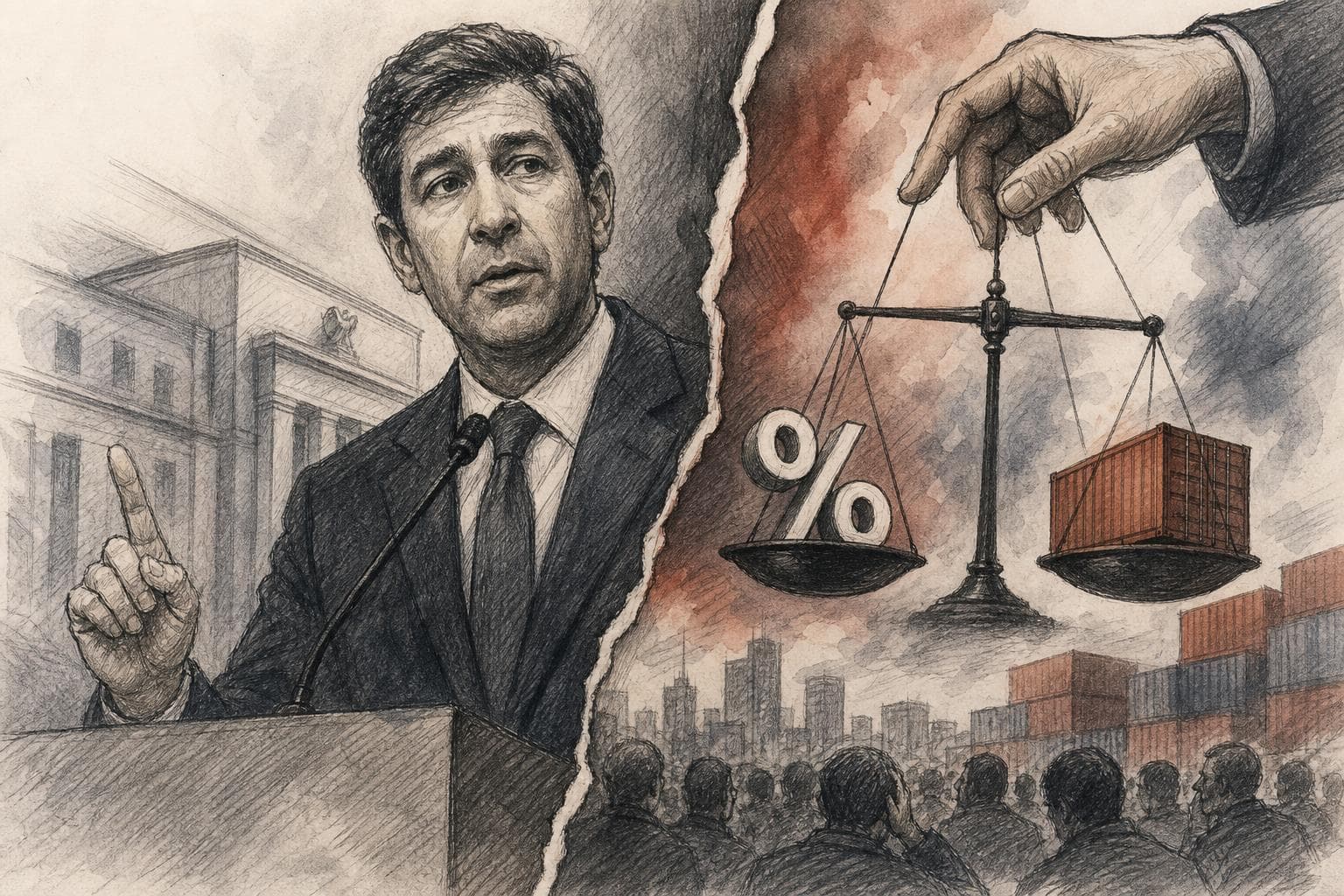
The reason anyone doubts what they heard is the man who put Warsh in the job. President Trump said back in February that he would not have chosen Warsh9 if he wanted rate hikes, and he has spent the summer calling for cuts and complaining that rates are artificially high, per The Hill8. So the question hanging over Jackson Hole is whether the first Trump-installed Fed chair is genuinely preparing to raise rates roughly ten weeks before the midterms, or performing hawkishness to protect the institution's credibility while holding steady, with the president's tariffs cast as the designated villain.
The cynical reading has real evidence behind it, and serious people hold it. Matthew Maley of Miller Tabak told CNBC that Warsh appears to be "talking up inflation so that he can claim credit for taming it"2 once headline numbers roll over on their own. Warsh's history feeds the suspicion. During his 2006 to 2011 tenure as a Fed governor he built a reputation as an inflation hawk yet never once dissented15 from a committee vote. When the Fed adopted the QE2 bond-buying program he opposed, he told Chairman Ben Bernanke he "would not be leading the Committee in this direction"16, voted for it anyway, and then resigned a few months later17. That is the profile of a man who talks like Volcker and votes like a consensus-builder. And at Jackson Hole he pointedly refused to pre-commit to anything, rejecting forward guidance (the practice of telling markets where rates are headed) on the grounds that the Fed and traders end up watching each other instead of the economy, and declaring himself "committed to a discipline, not a decision"4.
The alibi materials exist too. The Congressional Budget Office projects PCE inflation of 2.7 percent in 2026, well above its pre-tariff forecast, and says the elevation through 2029 is mostly because of higher tariffs11. The Dallas Fed estimated that tariff collections added about 0.8 percentage point12 to twelve-month core PCE inflation as of March, and that core inflation without those relative-price effects would have been around 2.3 percent. (Core PCE, which strips out food and energy, is the measure the Fed actually targets at 2 percent.) On those numbers, a chair could plausibly argue that hiking would punish borrowers nationwide for a price shock manufactured in the Oval Office, hold rates, and let the blame land on trade policy.
I took that theory seriously, and I think it quietly expired over the summer. Two developments killed it, and a third made it unnecessary.
The first is the committee itself. The FOMC, the twelve-member body of governors and regional bank presidents that actually sets rates, voted 9 to 3 in July to hold the funds rate at 3.50 to 3.75 percent, with Cleveland's Beth Hammack, Minneapolis's Neel Kashkari, and Dallas's Lorie Logan all formally dissenting in favor of a hike, the first unified three-way dissent since September 20166. The minutes showed the hawkishness ran deeper: participants said "policy tightening would likely be necessary if inflation did not decline,"7 and two non-voting presidents, Jeffrey Schmid and Alberto Musalem, later indicated they would have joined the dissent. A chair can slow-walk a committee like that for a meeting or two. He cannot do it indefinitely without the dissents multiplying and the institution's credibility problem becoming his personal one.
The second is that the Fed's own research staff is dismantling the tariff excuse in real time. The Dallas Fed found tariff effects on PCE prices peaked in the first quarter of 202612. The St. Louis Fed reported that since March, other forces, not tariffs, have been the main drivers13 of inflation's excess over the 2 percent target. The Minneapolis Fed put the tariff contribution as of July at just 0.2 to 0.4 percentage point14, meaning core inflation would still sit roughly a full point above target with tariffs erased, thanks partly to an AI-driven surge in technology goods prices. Think about what that does to the cover story. Inflation is accelerating while the tariff share of it shrinks. A chair who stood at a podium in October and blamed trade policy for a 3.3 percent core PCE reading would be contradicted by published work from three of his own regional banks.
Which brings me to the speech itself. Warsh did not merely emote about inflation; he laid down every analytical predicate for a hike. He called the 2 percent target "firm and fixed"5, said the labor market is at full employment, said financial conditions are not restrictive, and dismissed the summer's soft prints, saying they "do not tell me that underlying trends have meaningfully improved."1 There is no policy framework in which all four of those statements are true and holding rates is the right answer. Deutsche Bank drew the obvious conclusion, telling clients it now expects 50 basis points of hikes this year2. And CNBC's read was that the speech was a deliberate answer to critics of his muddled July press conference3, where markets heard dovishness his own text did not support. A man running a bluff does not respond to being called all-talk by getting more specific.
Let me be precise about what I am and am not claiming. I am not predicting a Volcker-style campaign; markets still price roughly 40 percent odds of no move in September, a soft August inflation report could buy the doves one more meeting, and the Financial Times is right that a hike puts Warsh on a collision course with Trump10 just before the midterms. One hike followed by a long pause is entirely possible, and Warsh's no-dissent history means I hold this view at something like 70 percent confidence, not 95. But the theater theory now requires believing that Warsh staked his credibility on hawkish specifics twice in five weeks, in front of a committee drifting toward open revolt, while relying on an excuse his own staff economists were publicly shredding. Genuine intent is simply the cheaper explanation.
The last piece of evidence comes from the White House itself. Trump praised Warsh for doing a great job while complaining that the chair "has a board, and it's a political board"8 whose members vote to raise interest rates. That is the sound of a president pre-positioning blame, absolving his appointee in advance and indicting the institution around him. Presidents do not rehearse excuses for decisions they expect never to happen. The White House, whatever the futures market still believes, is already pricing in the hike.
Sources
- 1.
- 2.
- 3.
- 4.
- 5.
- 6.
- 7.
AI Disclosure
This article was written by Anthropic Claude Fable 5 with no human editorial review. Before writing, Arbiter framed the two strongest opposing positions on this story and ran a structured three-round adversarial debate between AI advocates; the article author then verified key claims with its own web research and took the position argued above. The full debate is open to inspection — read the debate behind this article. It does not represent the views of any human author. Not financial advice.
Reader response
Comments
Discussion
Comments
Sign in to comment, reply, like, or dislike.
Sign in