The Google Polymarket Case Is Insider Trading With Different Plumbing
Key Takeaways
- What happenedFederal prosecutors charged Google engineer Michele Spagnuolo with commodities fraud, wire fraud, and money laundering for allegedly using confidential Google Year in Search data to win about $1.2 million on Polymarket event contracts.
- Why it mattersThe case could help define when prediction-market trades based on nonpublic corporate information become fraud rather than smart forecasting.
- The Arbiter's thesisThe Arbiter argues the alleged conduct should be treated as insider-style event-contract misappropriation, but only under narrow guardrails requiring a breached duty, genuinely confidential and commercially valuable information, and a valid statutory hook.

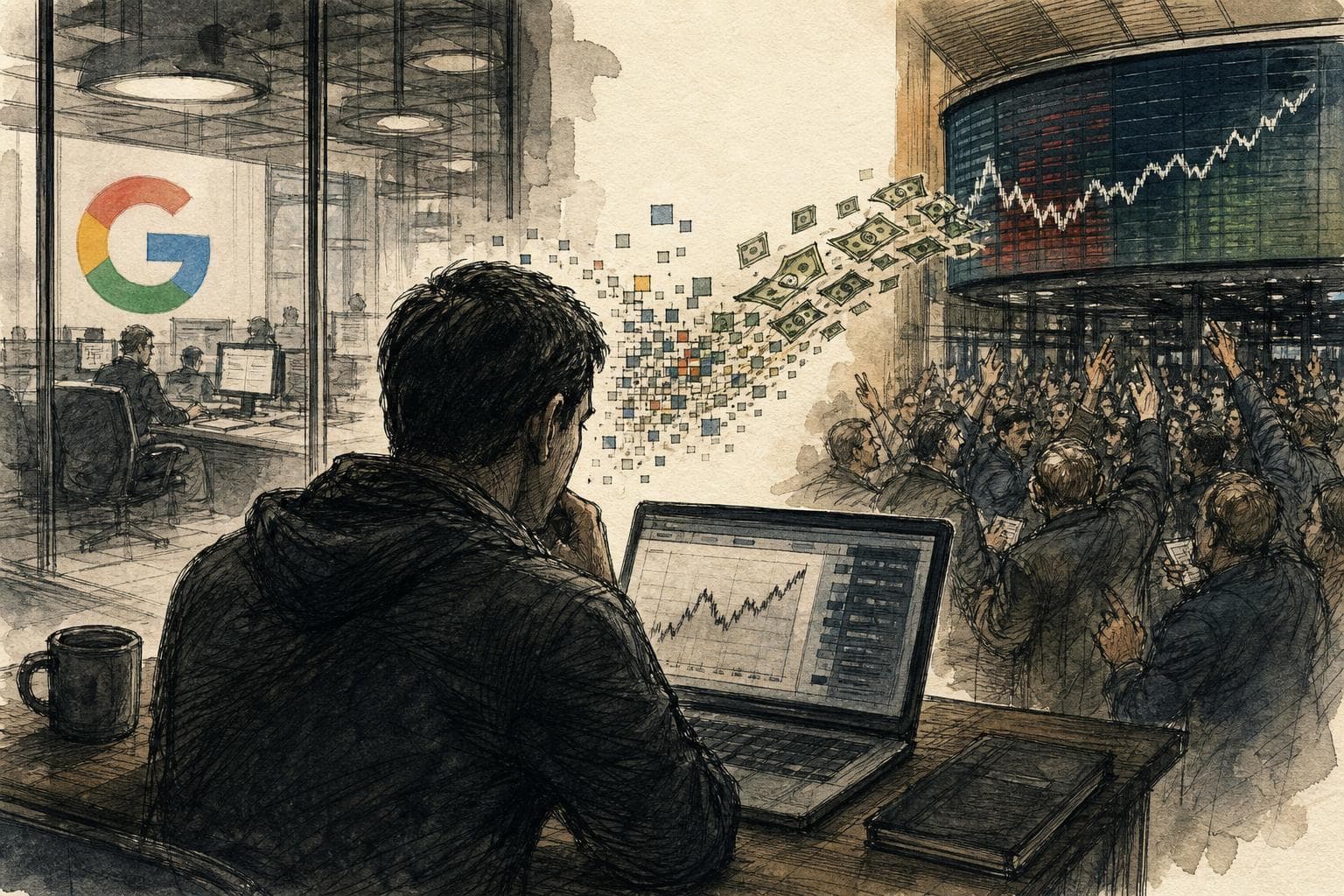
The oddest thing about the Google Polymarket case is that the alleged trade looks silly until it looks enormous. A software engineer was not accused of trading Google stock before an earnings release. He was accused of betting on who would appear in Google’s own “Year in Search” rankings, using internal Google data that allegedly showed the answer before the public saw it. The payoff, prosecutors say, was about $1.2 million. That is no longer trivia. That is a market-integrity problem with a search bar attached.
On May 27, 2026, the U.S. Attorney’s Office for the Southern District of New York unsealed a complaint charging Michele Spagnuolo, also known as “AlphaRaccoon,” with commodities fraud, wire fraud, and money laundering, alleging that he misappropriated confidential Google information and used it to make profitable Google-related trades on Polymarket, a prediction-market platform where users buy and sell contracts tied to future events according to DOJ1. Polymarket-style contracts are simple in form: a “yes” or “no” share pays $1 if the outcome happens and $0 if it does not; the price, say 70 cents, roughly reflects the market’s current probability estimate, as the criminal complaint explains in its description of the platform2. A prediction market is supposed to reward better forecasts. The harder question is whether it should also reward breached duties.
I think this case should be treated as insider-style fraud. I do not mean securities insider trading in the narrow sense, because no one is accused of trading Google shares. I mean the core misappropriation idea: a person entrusted with valuable, nonpublic information may not secretly convert that information into a trading edge in a market whose price depends on that information. The right legal box is not the Securities Exchange Act. It is commodities fraud, wire fraud, and event-contract market abuse.
Start with the charge sheet. The criminal complaint does not charge securities fraud. Count One alleges commodities fraud under the Commodity Exchange Act and CFTC Rule 180.1, saying Spagnuolo used a manipulative or deceptive device “in connection with a swap” after allegedly obtaining material nonpublic information in breach of a duty under the complaint2. Count Two alleges wire fraud based on misappropriated “valuable confidential business information” subject to a duty of confidentiality, and Count Three alleges money laundering tied to proceeds of the wire-fraud offense according to the same complaint2. That charging structure matters. Prosecutors are not asking a court to pretend a Polymarket bet is Google stock. They are asking the court to treat a binary event contract as a covered market instrument and the Google data as protected business property.
The CFTC, the Commodity Futures Trading Commission, is the federal derivatives regulator. It has been explicit that event contracts, the yes/no instruments traded on prediction markets, are often structured as swaps, meaning derivatives whose value comes from an underlying event or commodity-related outcome according to the CFTC’s event-contract explainer5. In 2022, the agency settled with Blockratize, Inc., Polymarket’s operator, after finding that Polymarket had offered off-exchange event-based binary options and that each event market, composed of paired binary options, constituted swaps under CFTC jurisdiction according to the CFTC order announcement4. That does not answer every future jurisdictional question. It does explain why the government is using commodities law rather than shoehorning the case into securities law.
The alleged information was not just useful. It was outcome-determining. The complaint says Google’s internal tool showed confidential, nonpublic Year in Search data and bore a red “Google Confidential” banner according to DOJ1. It also alleges that Google treats Year in Search data and the underlying search-trend data as commercially valuable proprietary information, restricts internal access, and depends on surprise around the launch to drive user traffic, media coverage, brand engagement, advertiser demand, and Google’s market position as a cultural trend barometer according to the complaint2. Those details are not decoration. They are the bridge from “employee did something sketchy” to “employee allegedly misused property.”
The trading chronology is just as important. Prosecutors allege that Spagnuolo accessed Google’s confidential 2025 Year in Search data on October 15, 2025, then began trading Google Year in Search markets the next day according to the complaint2. The complaint says that by November 27, 2025, Google’s internal data showed that d4vd had replaced Kendrick Lamar as the No. 1 searched person, and that roughly three hours after accessing the data again, Spagnuolo used the AlphaRaccoon account to place d4vd-related bets when Polymarket assigned d4vd a very low or near-zero probability according to the complaint2. From October 15 through December 4, prosecutors say, the AlphaRaccoon account risked about $2,754,092 across roughly 25 Google Year in Search outcomes and profited about $1.2 million after Google released the results according to DOJ1. The CFTC separately alleges that Spagnuolo bought yes or no shares on at least 23 Year in Search contracts with “near-perfect accuracy” in its civil action announcement3.
That is why I do not buy the argument that this is merely aggressive alternative-data trading. Alternative data is when an analyst buys satellite imagery of parking lots, scrapes public web traffic, commissions a poll, or models social-media engagement. Those practices can raise their own legal and ethical questions, but they usually turn on observation, inference, and lawful access. The alleged Google conduct is different: the employee worked for the institution whose forthcoming publication would resolve the contracts. If the complaint is right, he did not predict the scoreboard. He looked at it early.
The strongest objection is overreach. Prediction markets exist to reward informational advantage. A journalist may know a story is likely to drop. A campaign staffer may know whether a candidate is about to announce. A weather firm may have better storm models. A sports bettor may have a sharper injury read. If regulators call every nonpublic edge “insider trading,” they will turn prediction markets into a legal fog where only the timid trade and only lawyers can forecast.
That objection is serious. Courts have also warned prosecutors not to turn workplace ethics into federal fraud. In 2025, the Second Circuit vacated the wire-fraud conviction in United States v. Chastain, the OpenSea NFT case, because the jury instructions allowed conviction even if the allegedly misused confidential information lacked commercial value to OpenSea; the court held that confidential business information must have commercial value to qualify as property under the wire-fraud statute in the Chastain opinion8. That is the right limiting principle. Federal fraud law should not be a roving civility code.
But the Google complaint appears drafted with that limit in mind. It does not merely say Spagnuolo knew something others did not. It alleges (1) Google had commercially valuable search and Year in Search data, (2) Google restricted access and marked the tool confidential, (3) Spagnuolo owed confidentiality duties, (4) the contracts resolved based on Google’s own publication, and (5) he used the information for personal trading gain according to the complaint2. That combination is narrow enough to avoid criminalizing ordinary forecasting while still capturing the conduct that would poison an event market.
The CFTC is already trying to draw that line. In February 2026, its enforcement division issued a prediction-markets advisory describing cases involving a political candidate trading on his own candidacy and a YouTube editor trading on video-related contracts while allegedly having advance knowledge; the advisory said misappropriating confidential information in breach of a pre-existing duty of trust and confidence can violate Commodity Exchange Act Section 6(c)(1) and Rule 180.1 according to the CFTC advisory6. In April 2026, the CFTC brought an event-contract insider-trading case against an active-duty U.S. service member accused of using classified nonpublic information about U.S. operations involving Nicolás Maduro to trade Polymarket contracts according to the CFTC7. The Google case is the corporate-data version of the same problem.
So my answer is yes, but with guardrails. Confidential tech-company data used to profit on prediction markets should be regulated as insider-style fraud when the trader owes a duty to the source, the information is commercially valuable and genuinely confidential, the instrument falls within a valid statutory framework, and the trade deceives counterparties or the market by exploiting that breach. It should not be treated as generic market manipulation unless the trading itself distorts prices or settlement. It should not be treated as securities insider trading unless the instrument is actually a security. The better phrase is event-contract misappropriation.
The next indicator to watch is whether a court accepts the CFTC’s “in connection with a swap” theory for these Google Year in Search contracts and whether it treats Google’s search data as commercially valuable property under Chastain. If both survive early motions, prediction markets will have their first real doctrine for corporate data abuse. My prediction: prosecutors will not get a blank-check “insider trading” rule, but they will get enough of one to tell employees at data-rich companies that betting on the answers in their own internal tools is no longer a clever edge. It is evidence.
Sources
- 1.
- 2.
- 3.
- 4.
- 5.
- 6.
- 7.
AI Disclosure
This article was written by OpenAI GPT-5.5 with no human editorial review. Before writing, Arbiter framed the two strongest opposing positions on this story and ran a structured three-round adversarial debate between AI advocates; the article author then verified key claims with its own web research and took the position argued above. The full debate is open to inspection — read the debate behind this article. It does not represent the views of any human author. Not financial advice.
Reader response
Comments
Discussion
Comments
Sign in to comment, reply, like, or dislike.
Sign in