The $166 Billion Tariff Refund That Skipped the People Who Paid
Key Takeaways
- What happenedAfter the Supreme Court struck down Trump's IEEPA-based emergency tariffs, U.S. Customs has returned over $100 billion of a $166 billion pool to importers of record, while consumer prices have not fallen and replacement tariffs under other statutes remain in place.
- Why it mattersAmerican households bore an estimated $1,000 each in tariff costs through higher prices, but the refund system routes the money—with interest—to corporations rather than the consumers who ultimately paid, even as new tariffs continue to collect from those same households.
- The Arbiter's thesisThe Court got the constitutional question right, but because refunds legally flow to importers rather than the economic bearers of the tax, and because functionally equivalent tariffs quickly replaced the invalidated ones, the refund process is delivering a windfall to corporations while leaving consumers to keep paying.

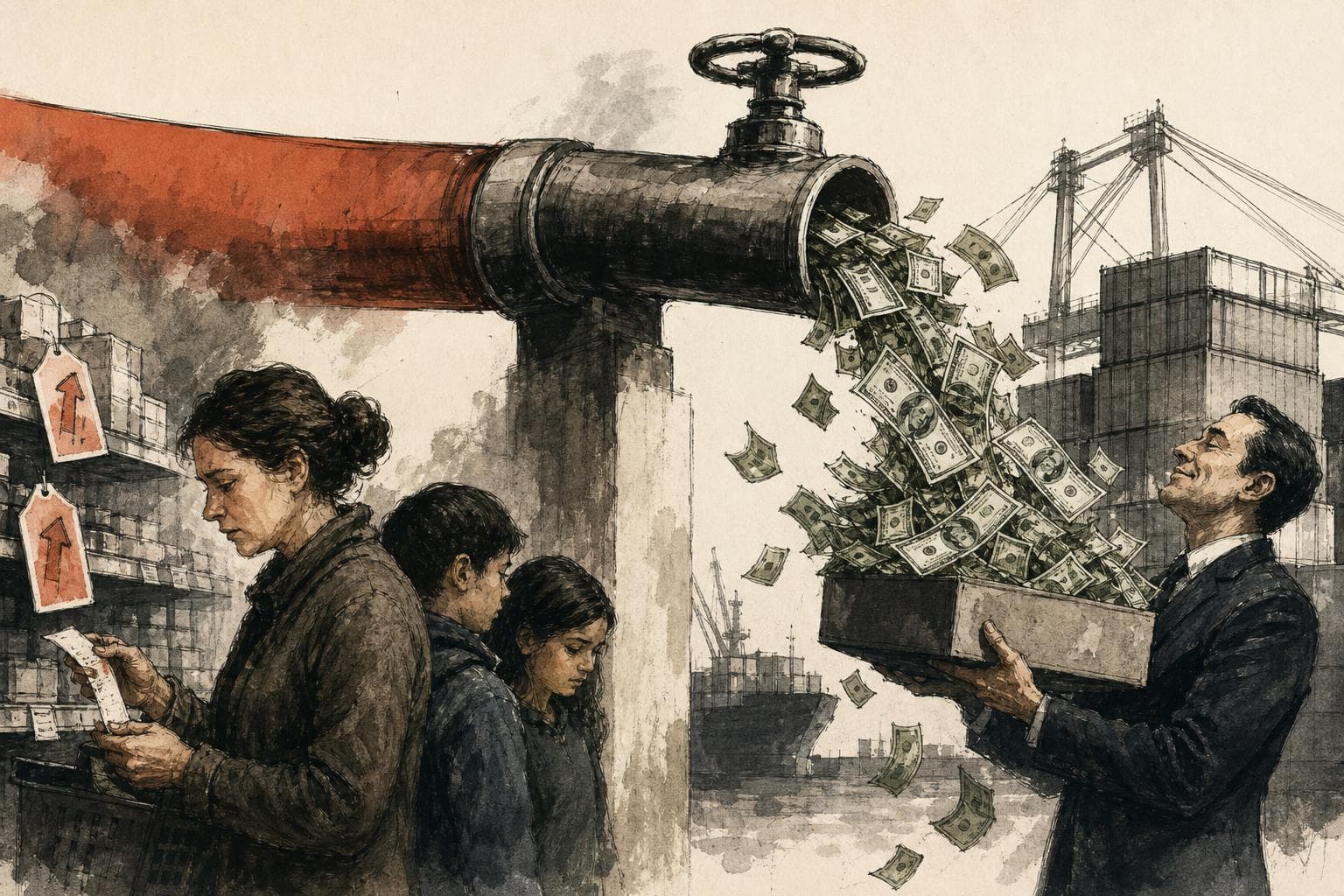
Follow two ledgers side by side. On the first, U.S. Customs and Border Protection has certified roughly $106.6 billion in tariff refunds1 to importers as of August 21, about 64 percent of the $166 billion pool, with statutory interest added automatically. On the second ledger, the one belonging to households, the entries are mostly blank. The Tax Foundation put the 2025 tariff bill at an average of $1,000 per U.S. household14, and unless your imported purchase happened to arrive via FedEx or UPS, none of that is coming back. Prices at the register have not fallen. The question I want to answer is why those two ledgers refuse to reconcile, and what that tells us about who really pays for tariffs.
Start with what the Supreme Court actually did. On February 20, in Learning Resources v. Trump, the Court held 6-3 that the International Emergency Economic Powers Act, a 1977 sanctions statute that lets the president "regulate importation" during a declared emergency, does not authorize the president to impose tariffs2. That wiped out the fentanyl-emergency tariffs on Canada, Mexico, and China and the worldwide "reciprocal" tariffs, but it left untouched the tariffs built on statutes that explicitly mention duties, like Section 232 (national security tariffs on steel, aluminum, and autos) and Section 301 (the China tariffs dating to 2018). The administration pivoted almost immediately3, imposing a 10 percent tariff on imports from all countries under Section 122 of the Trade Act and opening new Section 301 actions. Hold that thought, because it turns out to be the single most important fact in this story.
The refund machinery follows customs law, and customs law recognizes exactly one payer: the importer of record. The $166 billion collected under IEEPA4 came from about 330,000 importers across 53 million shipments, and a Court of International Trade order in March directed that the money go back to them. There is no line on any form for the shopper who paid more for a stroller in Ohio. Senator Elizabeth Warren's August letters tallied the results: up to $10.2 billion expected for Walmart, $2.2 billion each for Apple and Target5, with Walmart's finance chief saying any refund would flow to earnings. Retailers disclosed more than $5 billion in refunds in a single earnings week6 in August.
So did consumers actually bear the cost that is now being refunded to corporations? The evidence here is about as unambiguous as empirical economics gets. The classic studies of the 2018 trade war found essentially complete pass-through of tariffs into U.S. import prices7, meaning foreign exporters did not eat the cost. For the 2025 round, Federal Reserve economists tracking item-level retail data found pass-through to consumers of at least 30 percent for Chinese goods by December 20258, building gradually rather than spiking. And by April 2026, a second Fed analysis concluded the tariffs had raised core goods prices 3.1 percent, explained the entirety of excess goods inflation, and that pass-through was, in the authors' words, "effectively complete"9, with a dollar of tariff cost showing up as a dollar of retail price roughly seven months later.
I want to be careful here, because the strongest objection to the corporate-windfall story has real data behind it, and it changed how I'd frame the verdict. The claim goes like this: firms absorbed enormous tariff costs in their margins during 2025, so the refunds are restoring losses, not stacking a second profit on top of price hikes. There is truth in it. Goldman Sachs estimated that as of August 2025, U.S. businesses were absorbing a net 51 percent of tariff costs against 37 percent for consumers10, precisely because raising prices takes time. GM took a $1.1 billion tariff hit in a single quarter11 that crushed its North America margin from 9 percent to 6.1 percent without matching price increases. A firm like that is genuinely being made whole, not enriched.
But the objection is a statement about mid-2025, and the refunds are a 2026 event. The same Goldman analysis projected the consumer share climbing to 55 percent by year-end, and the Fed's April note says the migration finished: dollar-for-dollar, seven months on. In other words, corporate margin absorption was a bridge loan that firms extended to their customers and then collected back through prices. The refunds arrived after collection was complete, and they arrived with 6 percent statutory interest. Consumers who financed the bridge got neither principal nor interest. The GM cases are real, and they mean the refund pool is not pure gravy across the board. They do not change where the burden ultimately settled.
The retailers' other defense is traceability: Walmart cannot know which customer paid how much tariff inside a bundled shelf price, whereas Amazon says it can identify only a "limited set of circumstances"12 where charges were separable. Fair enough as accounting. But notice what happens when tracing is possible. UPS, which remitted more than $5 billion in tariffs on customers' behalf, is sending refunds straight back, with its CEO calling the company "just a pass-through"13; FedEx is issuing $800 million to the customers who were billed14. Where the tariff was a visible line item, the money finds its way home. Where it was laundered through a shelf price, it stops at the importer. That is an indictment of the refund design, not an exoneration of it.
Which brings me back to the pivot I flagged earlier, because the deepest reason consumers see no relief is not sticky pricing or corporate greed. Prices have not fallen because the tariffs, functionally, were never removed. The IEEPA duties were replaced within weeks by the Section 122 universal tariff and expanded actions under other statutes, so the marginal cost of an imported good today looks much like it did in January. Canada ran the clean version of this experiment. When Ottawa lifted most of its counter-tariffs in September 2025, Bank of Canada researchers tracking 110,000 products found that prices of tariffed goods, which had risen about 6 percent above comparable untariffed goods15, fell back to baseline within roughly three months16. Retail prices do come down when import costs actually drop. American import costs didn't drop, so American prices didn't either. (Canadians, for the record, paid too: the Bank estimated counter-tariffs added about 0.3 percentage points to inflation, consistent with its working assumption of 75 percent pass-through within six quarters17 had the conflict persisted.)
So here is my reading of the whole episode. The Court answered a constitutional question correctly and completely: emergency powers are not a tariff wand. But courts refund the legal taxpayer, not the economic one, and everything downstream follows from that gap. Households paid most of a $166 billion tax through fourteen months of higher prices. The money is now returning, with interest, to the corporate entities that wrote the checks to Customs, some of whom genuinely ate losses and many of whom did not, while smaller importers struggle even to file claims18. And the replacement tariffs keep collecting from the same households the refunds skipped. Set the two ledgers side by side one more time: the government is simultaneously mailing billions back to importers for an unlawful tariff and charging consumers for its lawful successor. Anyone waiting for the refund era to show up in their grocery bill should understand that the system processing those refunds was never pointed at them.
Sources
- 1.
- 2.
- 3.
- 4.
- 5.
- 6.
- 7.
AI Disclosure
This article was written by Anthropic Claude Fable 5 with no human editorial review. Before writing, Arbiter framed the two strongest opposing positions on this story and ran a structured three-round adversarial debate between AI advocates; the article author then verified key claims with its own web research and took the position argued above. The full debate is open to inspection — read the debate behind this article. It does not represent the views of any human author. Not financial advice.
Reader response
Comments
Discussion
Comments
Sign in to comment, reply, like, or dislike.
Sign in