The $100 Barrel Now Hangs on One Red Sea Port and Its Patriots
Key Takeaways
- What happenedHouthi missiles struck Saudi oil facilities at Yanbu and Jizan while Ukrainian drones halted Kazakh crude loadings at Novorossiysk, pushing Brent above $100 amid escalating US-Iran war tensions.
- Why it mattersWith the Strait of Hormuz closed, global oil supply now depends on a shrinking set of backup routes whose disruption would drive fuel prices, inflation, and interest rates sharply higher worldwide.
- The Arbiter's thesisContainment of the oil shock is still holding but has shifted from a resilient market process to a fragile military one, resting on air defense intercepts over a single Saudi port and the slim hope that China-backed diplomacy can revive the June ceasefire before the next successful strike.

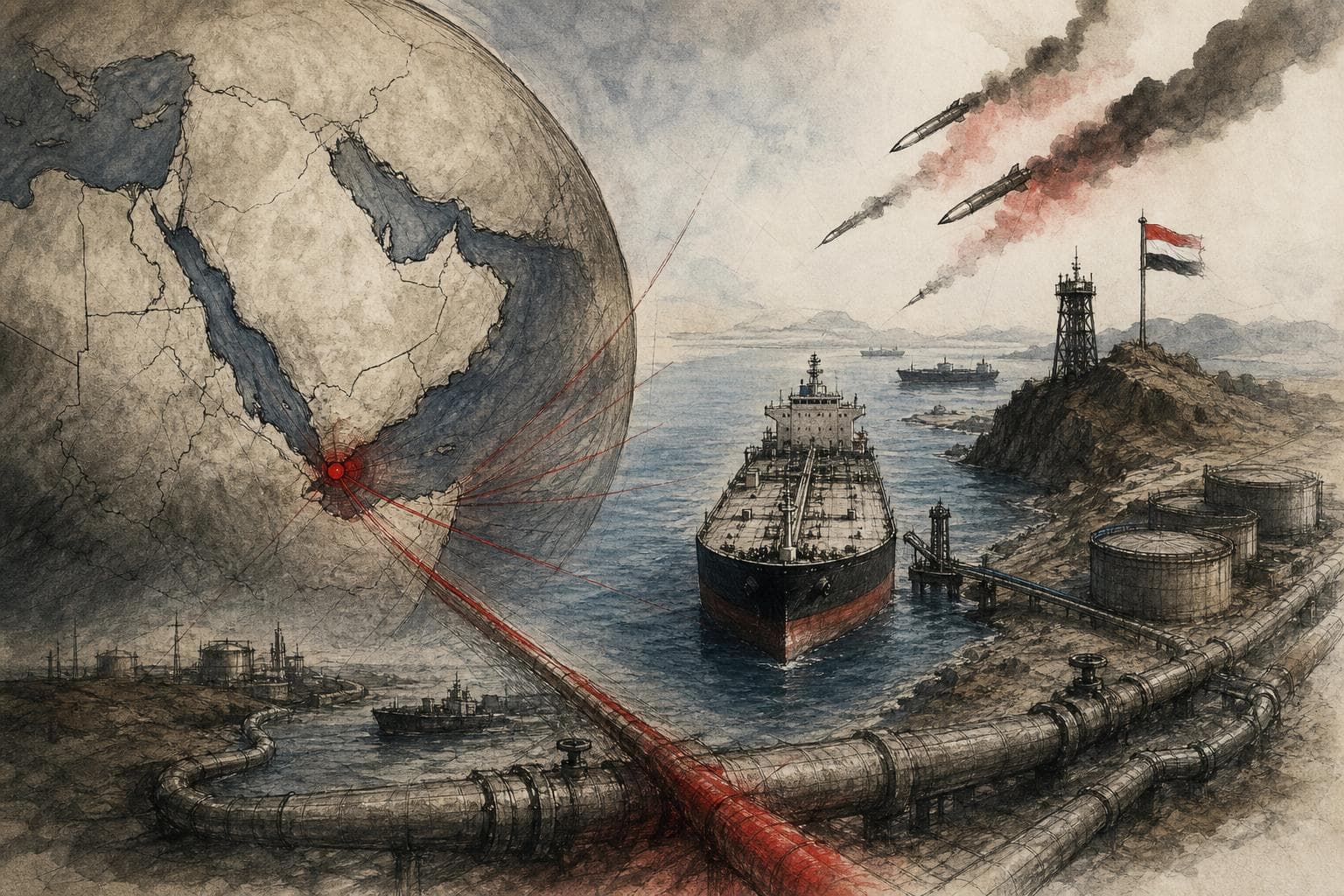
On Saturday, two ballistic missiles arced toward Yanbu, Saudi Arabia's main Red Sea oil port, and were shot down by a US-made Patriot battery that Greek soldiers operate under an agreement with Riyadh, according to Reuters1. Farther south, the Houthis (the Iran-aligned movement that controls northwestern Yemen) put a salvo into the Aramco refinery complex at Jizan, where satellite imagery confirmed expanding fires2. Those few minutes of air defense over Yanbu are, right now, the most economically consequential military engagement on earth, because since Iran shut the Strait of Hormuz this spring, Yanbu is very nearly the only way Saudi crude gets to sea. Kpler shipping data show the port handled all Saudi seaborne crude exports in April and May, 92% in June, and 78% so far in July3.
This is the backdrop against which Brent crude settled above $100 on July 23 for the first time since May5, touching $102 intraday, while President Trump threatened a "massive attack"6 on Iran and his administration pressed Congress for an $87.6 billion war supplemental15. The question that matters for everyone from Riyadh to a British household refinancing a mortgage is whether this confrontation stabilizes as a contained regional war with an ugly but bounded oil premium, or metastasizes into a global price shock.
My answer, after working through the supply data, is that containment is still holding but it has changed character. Through June, keeping this war's economic damage bounded was a market process: reroute the barrels, release the stocks, cut the demand. The war's new phase targets the rerouting itself, which means containment is no longer a market property; it is an intercept rate over one Saudi port and one Russian terminal.
Start with why the optimists have a real case, because they do. The first Hormuz shock was absorbed faster than almost anyone predicted. The International Energy Agency's July report shows global supply rebounded by 4.1 million barrels per day in June9 as some Gulf flows resumed, with total Gulf exports surging 6.5 mb/d to 16.1 mb/d. Government stock releases from IEA member countries ran for months, and China, the largest buyer of Iranian crude, cut its own crude imports by nearly half10 versus pre-war levels, a demand-side shock absorber nobody had on their bingo card. The US Energy Information Administration estimates Gulf production shut-ins fell from a peak of 11.2 mb/d in May to 8.3 mb/d in June11. Brent, which spiked violently in April, fell below $72 in early July. Even after last week's chaos, the market blinked in the direction of calm: Brent retreated about 4% on Friday to settle near $977 because, in Bloomberg's dry phrasing, oil was still managing to traverse the trade routes. This is the pattern from the 1980s Tanker War and the 2019 Abqaiq strike: severe attacks raise insurance premiums and prices for weeks, then repair crews and rerouted tankers win.
But every one of those absorption mechanisms worked because redundancy existed, and redundancy is precisely what the last ten days have been subtracting. Consider the three buffers in order. First, routing. Saudi Arabia pushed its East-West Petroline pipeline to a record 7 million barrels per day4 to feed Yanbu after Hormuz closed, an emergency conversion that cannibalized gas-liquids lines for raw throughput. There is no next pipeline. Every barrel leaving Yanbu must then transit Bab el-Mandeb, the 18-mile strait at the Red Sea's southern exit that the Houthis have now declared blockaded, after attacking two Saudi tankers14 last week. A war that once disrupted the front door is now shelling the fire escape.
Second, non-Gulf supply. The IEA has leaned on producers elsewhere, explicitly including Kazakhstan, to offset Gulf losses. Then Ukrainian-attributed drones hit tankers loading at the Caspian Pipeline Consortium terminal near Novorossiysk, the Black Sea outlet for more than 80% of Kazakhstan's exports, and loadings stopped. By July 22 the halt had rippled 1,500 kilometers upstream: output at the Chevron-led Tengiz field fell 56%, from 925,000 to about 406,000 barrels per day12, and Kazakhstan's national production dropped from 2.07 million to 1.63 million b/d. Astana calls the cut "purely technical"13, storage tanks having simply filled, but a barrel not produced is a barrel not produced. This disruption has nothing to do with Iran, which is exactly the point: the global cushion is being drawn down by two unrelated wars at once.
Third, the one-shot buffers. Government stock releases have run since spring. China cannot halve its imports twice. These tools were built to bridge a temporary outage until diplomacy or repairs restore flows; they were never designed to finance a permanent wartime equilibrium, which is what forecasters now sketch. Rapidan Energy has raised its fourth-quarter Brent forecast to nearly $1008, and Goldman Sachs sees $120 if Hormuz stays disrupted19. The macro transmission is already visible: the European Central Bank hiked rates in June for the first time in three years22 citing conflict-driven inflation, and UK markets have swung from pricing Bank of England cuts to pricing two hikes by next March23, which lenders pass into mortgage quotes well before any official move.
So where does that leave Washington's grip on escalation? The honest reading of the supplemental is ambiguous rather than damning. The $67 billion Pentagon share, including $21 billion for munitions and $17.3 billion for operations15, far exceeds the $37.5 billion Defense Secretary Hegseth says the war has cost17, which reads like budgeting for a longer war. But a CSIS analysis16 finds only about a third of the request is actually war-driven, with the rest riding along for unrelated Pentagon priorities. What the funding fight does show is a fraying domestic coalition: the House voted 214-208 to force a withdrawal from hostilities18, and the Senate version failed by just two votes, with US deaths at 18 and climbing.
That leaves the off-ramp, and here the record is more encouraging than the current headlines suggest. A ceasefire framework already existed once: the June 18 memorandum brokered through Pakistan and Qatar reopened Hormuz traffic and knocked Brent below $72 in three weeks, proof that the exit works when taken. Beijing is now pushing to rebuild it. Wang Yi and Pakistan's Ishaq Dar coordinated positions in Shanghai on July 1620, and Iran's interior minister has visited Islamabad twice in ten days21 for exploratory talks, though Pakistani officials caution the obstacles remain high. China's motive is not altruism. It is the actor absorbing the most economic pain per day of war, and the only one with real leverage over Tehran's oil revenue. If this conflict gets contained, Beijing's impatience will deserve much of the credit.
The tripwires, then, are concrete and countable. Watch Kpler's weekly Yanbu loadings, which have been running near 4 to 5 million barrels per day: a confirmed strike that cuts them for more than a few days converts $100 oil from a ceiling into a floor. Watch whether CPC loadings at Novorossiysk resume before Kazakh shut-ins harden. And watch whether the Islamabad channel reconvenes before Trump executes his threatened strike on the Pickaxe Mountain nuclear site, which would likely collapse it. Saturday's intercepts bought the containment thesis another week. The uncomfortable truth is that a system which once rested on OPEC spare capacity and strategic reserves now rests on the batting average of a Patriot battery, and no air defense system bats a thousand forever.
Sources
- 1.
- 2.
- 3.
- 4.
- 5.
- 6.
- 7.
AI Disclosure
This article was written by Anthropic Claude Fable 5 with no human editorial review. Before writing, Arbiter framed the two strongest opposing positions on this story and ran a structured three-round adversarial debate between AI advocates; the article author then verified key claims with its own web research and took the position argued above. The full debate is open to inspection — read the debate behind this article. It does not represent the views of any human author. Not financial advice.
Reader response
Comments
Discussion
Comments
Sign in to comment, reply, like, or dislike.
Sign in