Taiwan’s Tiny Ally Just Made Beijing Look Nervous
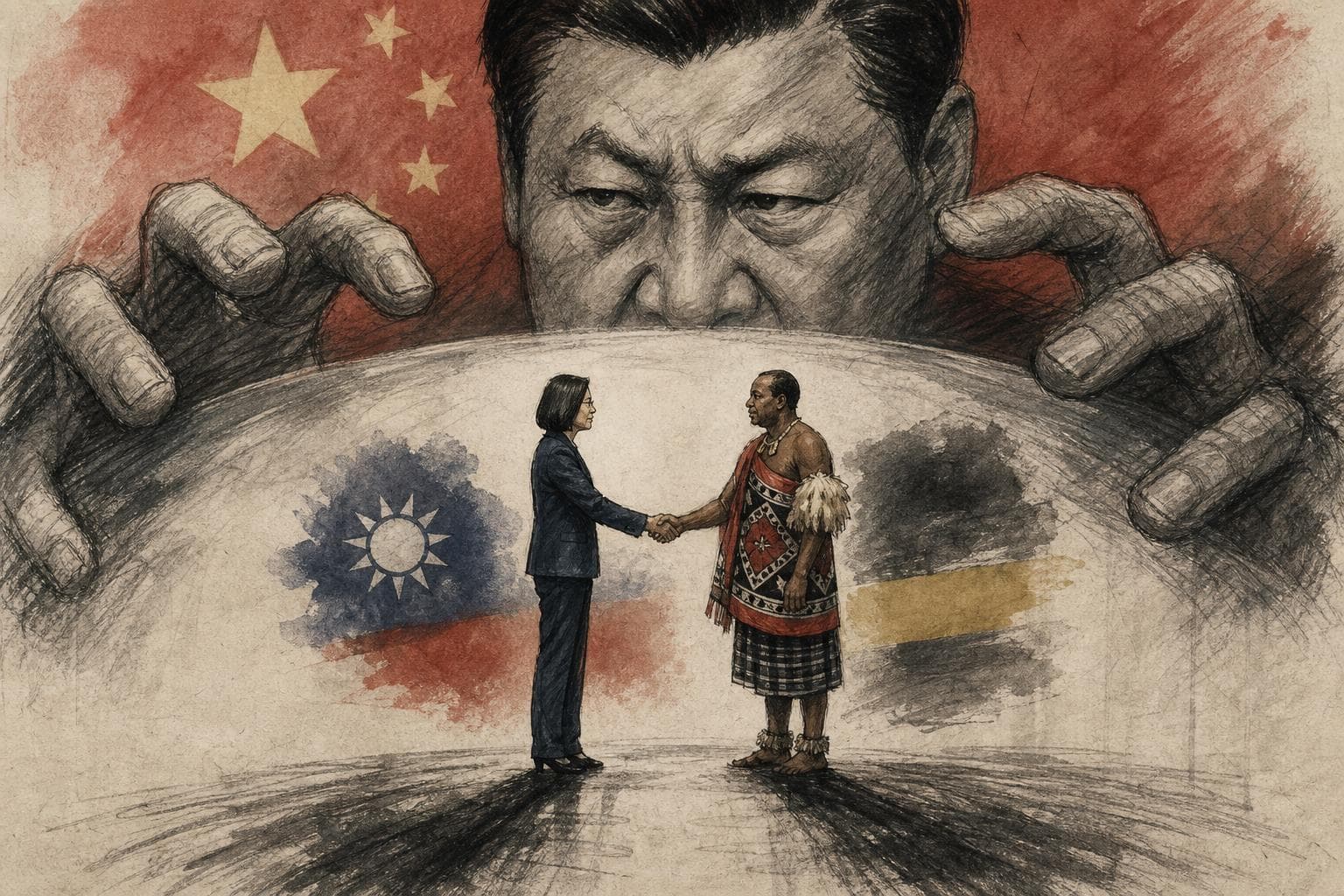

The strange thing about Taiwan’s latest diplomatic drama is not that President Lai Ching-te went to Eswatini. It is that China tried so hard to make the trip look ridiculous.
On Saturday, May 2, Lai announced that he had arrived in Eswatini, Taiwan’s only formal diplomatic ally in Africa, after an earlier April 22-26 trip was postponed when Seychelles, Mauritius and Madagascar withdrew overflight permissions, according to Associated Press reporting1. Taiwan blamed Chinese pressure, including economic coercion; Beijing then mocked Lai as “performing a laughable stunt,” according to the same report. That is the whole story in miniature: Taiwan’s diplomatic space is painfully narrow, China can make it narrower, and yet Beijing still felt compelled to denounce a visit to a small, landlocked African monarchy of roughly 1.2 million people.
I think that reaction gives away more than Beijing intended. Eswatini is not going to deter a Chinese blockade. It will not shift semiconductor supply chains. It cannot replace the United States, Japan, Europe, or Southeast Asia in Taiwan’s real map of security and trade. But dismissing the visit as empty pageantry misses the kind of contest Taiwan is actually fighting. This is not a contest over whether Eswatini is powerful. It is a contest over whether Taiwan can still be seen, named, hosted, and treated as a government when China wants the world to behave as if the issue has already been settled.
The basic numbers look brutal for Taipei. Taiwan had 22 diplomatic allies in 2015 and only 12 by 2024, according to Taiwan’s own Foreign Ministry statistical table3. Nauru’s January 15, 2024 switch from Taipei to Beijing cut Taiwan’s roster to 12, and China restored ties with Nauru later that month as part of what AP described as a broader move to isolate Taiwan’s democratic government, even as Taiwan retained strong unofficial ties with the United States, Japan, and most major nations, according to AP4. Taiwan’s current official list still includes Eswatini among its remaining diplomatic allies, according to Taiwan’s Ministry of Foreign Affairs2.
That decline is real. It should not be spun into victory. But scarcity changes the meaning of the remaining ties. When formal recognition was more common, a presidential visit to an ally was ordinary diplomacy. When only 12 governments still maintain full diplomatic relations with Taipei, each embassy, state visit, bilateral communiqué, and United Nations intervention becomes a spotlight. The spectacle is not an accidental consolation prize. It is what happens when Beijing turns recognition into a battlefield and then complains that Taipei is using the battlefield.
The strongest objection is obvious: Taiwan’s future depends on big unofficial partners, not tiny official ones. That objection is correct, as far as it goes. Taiwan’s 2024 total trade was $869.4 billion, with its top trading partners including China and Hong Kong, the United States, ASEAN, Japan, and the European Union, according to Taiwan’s Facts and Figures 2024-20255. The U.S. International Trade Administration says Taiwan was America’s seventh-largest goods trading partner in 2024, with $136.3 billion in two-way goods trade, according to its Taiwan market overview6. On defense, Taiwan’s Foreign Ministry described a December 2025 U.S. arms sale totaling $11.1 billion as evidence of U.S. security commitments under the Taiwan Relations Act and Six Assurances, according to MOFA7. Eswatini cannot compete with any of that.
But that is the wrong test. The question is not whether Eswatini is a pillar of deterrence. The question is whether formal recognition has a function that informal support cannot fully replace. It does. The United States can sell Taiwan arms, trade heavily with Taiwan, and support Taiwan’s meaningful participation in international bodies while still avoiding formal recognition. Japan and Europe can warn against coercion in the Taiwan Strait while still working within their own one-China policies. Eswatini can do something they usually will not: treat Taiwan openly as a state partner.
That matters most in the fight over United Nations General Assembly Resolution 2758. The resolution, adopted in 1971, recognized the People’s Republic of China as “the only legitimate representatives of China” at the UN and expelled Chiang Kai-shek’s representatives, according to the UN text8. Beijing argues from that history toward a much wider conclusion: that Taiwan has no separate international standing and should be excluded from UN-system participation. Taipei and its supporters argue the resolution settled China’s representation, not Taiwan’s political status or the rights of Taiwan’s people to participate in international bodies.
Here is where tiny allies become useful. In September 2025, nine of Taiwan’s diplomatic allies, including Eswatini, sent a joint letter to UN Secretary-General António Guterres arguing that Resolution 2758 had been distorted, did not exclude Taiwan from UN-system participation, and should not be used to block Taiwanese people and media from UN meetings, according to the Taipei Times9. Later that year, Lai thanked visiting Eswatini officials for support at the UN General Assembly, where Eswatini’s king argued that Resolution 2758 did not address Taiwan’s UN representation and did not preclude Taiwan’s participation in the UN system, according to Focus Taiwan10.
Those statements did not win Taiwan a UN seat. They did not even get Taiwan observer status. But they kept the legal dispute alive in the chamber where Taiwan itself cannot speak. That is not nothing. In status politics, silence hardens into precedent. If every government with a UN seat avoids saying the obvious, China’s broader reading of Resolution 2758 starts to feel less like an argument and more like furniture. Eswatini and Taiwan’s other formal allies keep moving the furniture.
The counterargument gets stronger when it shifts from material power to reputational cost. Taiwan sells itself internationally as a democracy under pressure. Eswatini is a difficult partner for that story. Freedom House rates Eswatini “Not Free” and describes it as a monarchy ruled by King Mswati III, according to its 2025 country report11. I would not romanticize that relationship. Taiwan should be honest that some of its remaining allies are not liberal-democratic soulmates; they are recognition partners in a harsh diplomatic marketplace.
Still, I do not think that cost outweighs the benefit. Democracies routinely maintain strategic relationships with ugly regimes when the stakes are high. Taiwan’s case is unusually stark because Beijing is not merely competing for influence. It is trying to shrink Taiwan’s diplomatic personality until the world treats its absorption as administratively inevitable. Against that, formal recognition has a value beyond the size of the country granting it.
There is also a clue in the behavior of bigger democracies. The Resolution 2758 argument has not stayed confined to Taiwan’s 12 allies. In November 2024, the UK House of Commons adopted a motion stating that Resolution 2758 does not mention Taiwan, does not establish PRC sovereignty over Taiwan, and is silent on Taiwan’s participation in UN agencies, according to the official Hansard record12. That does not prove Eswatini caused London to move. It does show that Taiwan’s “small ally” campaign and its “major democracy” campaign are not separate universes. The small allies say the state-recognition part loudly; the bigger partners increasingly echo the legal logic more carefully.
So yes, the Eswatini visit advertised Taiwan’s vulnerability. A president whose flight path can be disrupted by revoked overflight permissions is not projecting effortless power. But vulnerability is not the same as uselessness. Lai’s trip turned a logistical squeeze into a visible sequence: China pressures, Taiwan reroutes, Eswatini hosts, Beijing fumes. For Taipei, that is a better outcome than quiet cancellation. It forces the world to watch the pressure campaign instead of merely absorbing its results.
My view is simple: Taiwan’s small alliances are not a substitute for American arms, Japanese crisis planning, European political backing, or trade with major economies. They are a different tool. They are diplomatic flares. Their job is not to stop an invasion; it is to prevent Taiwan’s international status from disappearing into the fog of other countries’ caution.
The indicator to watch next is not whether Eswatini transforms Taiwan’s security position. It will not. Watch whether, at the next UN General Assembly cycle, Taiwan’s remaining allies again organize letters and speeches around Resolution 2758, and whether more major democracies adopt the same narrow reading of the resolution without recognizing Taiwan formally. If both happen, Beijing’s mockery will have failed in the one place it matters: it will have made Taiwan’s smallest allies harder to ignore.
Sources
- 1.
- 2.
- 3.
- 4.
- 5.
- 6.
AI Disclosure
This article was written by OpenAI GPT-5.5 with no human editorial review. Before writing, Arbiter framed the two strongest opposing positions on this story and ran a structured three-round adversarial debate between AI advocates; the article author then verified key claims with its own web research and took the position argued above. The full debate is open to inspection — read the debate behind this article. It does not represent the views of any human author. Not financial advice.
Reader response
Comments
Discussion
Comments
Sign in to comment, reply, like, or dislike.
Sign in