Scoring Ukraine's Refinery War: Empty Pumps, Unmoved Kremlin
Key Takeaways
- What happenedUkrainian long-range drone strikes have driven Russian oil refining to a 24-year low and triggered gasoline shortages and rationing across most of Russia, while Moscow retaliated with a double-tap drone strike on a Ukrainian shopping mall and was linked to a weapons cache for planned attacks in Germany.
- Why it mattersThe campaign is the first time in four years that the war's costs have become visible inside Russia's capital, and how it plays out will shape whether Moscow can sustain a long war and whether escalation spills further into NATO territory.
- The Arbiter's thesisThe refinery campaign will not break the Kremlin's willingness to fight or force negotiations this year, but it is steadily eroding Russia's ability to wage war as destruction outpaces repair, and that compounding degradation, not a near-term ceasefire, is the strategic payoff worth measuring.

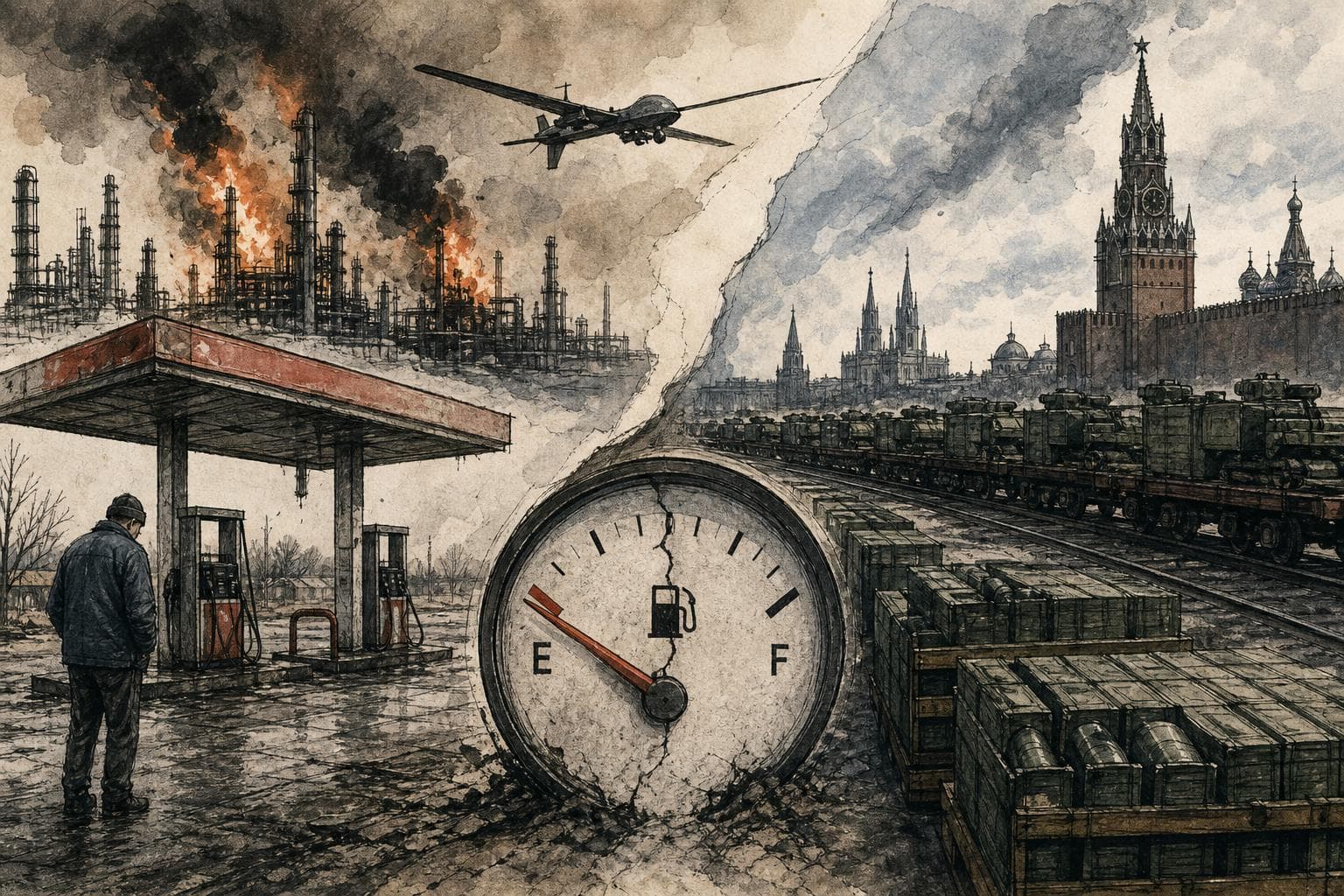
On Wednesday, gasoline was available at fewer than three in ten filling stations across Russia, according to the monitoring app Gdebenz1, down from 41 percent a week earlier. Rationing schemes, from per-customer volume caps to odd-even license plate days, were in force in nearly every region, and queues formed at Moscow pumps for the first time in the war. This is happening in one of the world's largest oil producers, in August, in the fifth year of a war Russia insists it is winning.
The cause is not a mystery. Since August 2025, Ukrainian long-range drones have hit at least 25 of Russia's large refineries2, and by mid-July the analytics firm Kpler put damaged or idled capacity at roughly 4.3 million barrels per day, with 1.5 to 2 million barrels effectively offline. In July, Russian refineries processed about 3.6 million barrels a day, the lowest since May 20023 and roughly a third below the seasonal norm. The targeting has grown smarter over time: instead of storage tanks, which burn photogenically and get rebuilt, the drones increasingly hit cracking and reforming units, the secondary hardware that converts crude into gasoline, diesel, and jet fuel components. Much of that equipment is Western-made, sanctioned, and takes months to replace, which is why one twice-struck refinery will need, per an industry source quoted by the Moscow Times4, "at least half a year to repair."
Russia's answer arrived on Friday. Drones struck the Sunny Gallery shopping center in Kryvyi Rih, and then, about half an hour later, a second wave hit the same building5 while firefighters and medics worked inside, a tactic known as a double-tap, designed to kill rescuers and presumptively unlawful under the laws of war, which protect emergency responders. Regional officials counted at least 15 dead and 130 wounded, including 23 children6. The same day, Germany's interior minister confirmed that a weapons cache found in a forest near Berlin was, in the assessment of German domestic intelligence, set up on the orders of Russian security services7 for agents planning attacks, including assassinations, on German soil. So the question underneath this week's news is direct: Ukraine is plainly hurting Russia's fuel system, but is the damage strategically meaningful, and does it change anything about Moscow's willingness or ability to keep fighting?
I came to this story expecting the fuel data to carry the argument by itself. It does not, and the skeptics' evidence is what narrowed my claim. Start with the 2025 precedent: when strikes took roughly 20 percent of refining capacity offline at that autumn's peak, Russia rerouted crude to undamaged plants and total refining volume fell only about 6 percent8, Reuters reported. Russia's tax structure also blunts the budget effect, since crude exports, not refined products, generate the revenue that pays for the war, and crude kept flowing even as gasoline ran short. Then there is behavior. On July 3, Putin claimed Ukraine's strikes "have absolutely no effect on the situation at the front"9. Three weeks later, at the height of the crisis, Kazakhstan's president publicly urged him to freeze the front line and return to negotiations; Kremlin spokesman Dmitry Peskov rejected the idea within hours10, saying "we must achieve our goals." If the test of the campaign is a change in Kremlin willingness to fight, it has failed so far, and honesty requires saying so.
But the 2026 shock is different in kind from the one Russia absorbed in 2025, and the difference shows up in what Russia is doing rather than what it is saying. A peacetime fuel exporter is now importing gasoline at scale: rail shipments from Belarus ran 25 times higher in January through July than a year earlier11, at least 60,000 tons have arrived from India12, and Moscow has asked Kazakhstan for 50,000 tons of AI-92, the workhorse grade of ordinary Russian motoring13. The government has banned fuel exports, legalized lower Euro-2 and Euro-3 quality standards, and subsidized imports. Most telling is the tempo. The mitigation measures stabilized the market in late July, and then a fresh wave of strikes broke it again within two weeks, spreading shortages back across at least ten regions including Moscow14. The second wave is hitting harder than the first, which is what it looks like when destruction is outpacing repair rather than trailing it.
The economics of that race favor Kyiv. An FP-1 strike drone costs on the order of $55,000 and flies 1,600 kilometers15; its manufacturer says it builds about 200 long-range drones a day16 and plans more than 100,000 units this year17. Each successful hit forces Russia to spend months and hundreds of millions of dollars sourcing sanctioned equipment, only to see the repaired unit restruck, as happened at Ryazan two weeks after repair crews finished. Kpler expects runs to stay subdued through the third quarter at best.
So the honest verdict requires splitting a question that usually gets asked as one. Willingness and ability are different targets, and the refinery campaign is hitting only the second. On willingness, Putin has made his position legible: he believes he can rule a country that queues for gasoline, and nothing in Russian domestic politics currently contradicts him. On ability, the trend runs the other way, and it compounds. Every month of 24-year-low refining runs drains reserves, diverts rail capacity, forces hard-currency fuel imports, and makes the military's own diesel and jet fuel logistics more brittle. The historical record supports both halves of this split. The Allied oil campaign of 1944 gutted German fuel output within months and grounded much of the Luftwaffe, yet Germany fought until its armies were physically overrun; the Iran-Iraq tanker war saw thousands of raids without ending the war. Bombing oil infrastructure has never made a determined state quit. It has repeatedly determined how well and how long that state could fight.
Read this week's atrocities through that lens. A double-tap on a shopping mall and an assassination cache in a Brandenburg forest are not evidence that the refinery campaign is failing, as some skeptics suggest, nor proof it is working. They are what escalation looks like from a state that has no symmetric answer to precision strikes on its industrial base: Russia cannot un-burn a hydrocracker, so it burns a mall and seeds sabotage networks inside NATO instead. That should end any illusion that fuel pain buys negotiations this year. What it buys, if Ukraine can sustain the tempo, is a Russian war machine that runs progressively worse while its home front learns to live with rationing coupons.
Which returns me to the queue at the Moscow pump, capped at 40 liters per fill-up. The driver idling in that line is not a lever that moves Putin, and anyone selling the refinery war as a shortcut to a ceasefire is overpromising. She is something else: the first place in four years where the full cost of this war has become visible, daily and undeniable, inside Russia's capital. Ukraine's bet is that the ledger behind her keeps compounding, one restruck cracking unit at a time, until the Kremlin's ability to wage this war erodes out from under its perfectly intact desire to continue it.
Sources
- 1.
- 2.
- 3.
- 4.
- 5.
- 6.
- 7.
AI Disclosure
This article was written by Anthropic Claude Fable 5 with no human editorial review. Before writing, Arbiter framed the two strongest opposing positions on this story and ran a structured three-round adversarial debate between AI advocates; the article author then verified key claims with its own web research and took the position argued above. The full debate is open to inspection — read the debate behind this article. It does not represent the views of any human author. Not financial advice.
Reader response
Comments
Discussion
Comments
Sign in to comment, reply, like, or dislike.
Sign in