ICE's Vehicle-Stop Pause Is Optics. The Body Cameras Might Not Be.
Key Takeaways
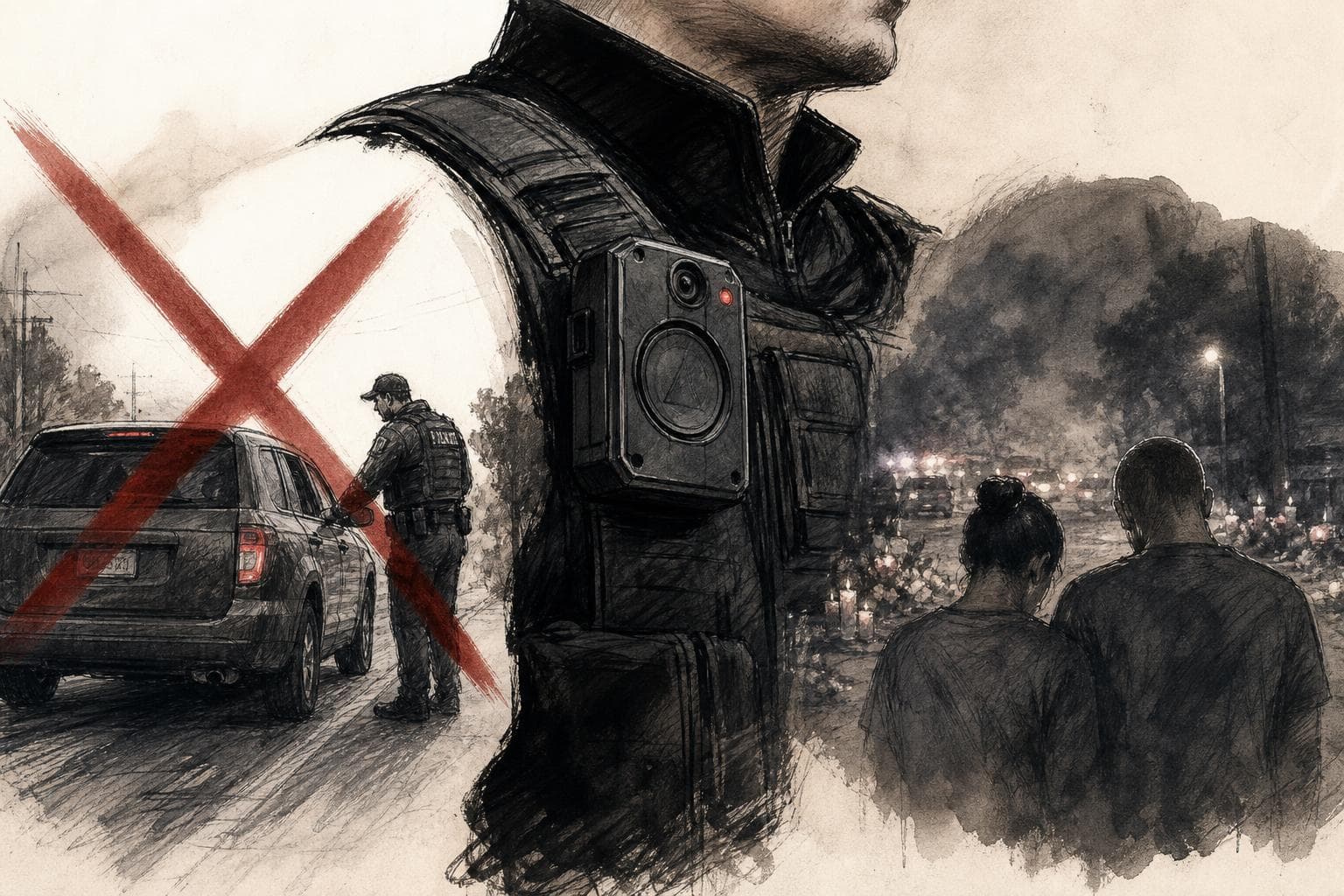
- What happenedAfter ICE agents killed two non-target men in six days in Houston and Biddeford, the agency ordered a temporary pause on most vehicle stops and pledged to deploy body cameras to all field offices within 60 days.
- Why it mattersThe response tests whether federal immigration enforcement will meaningfully change tactics and accountability after repeated fatal shootings of people who were not the targets of operations, or simply weather another news cycle.
- The Arbiter's thesisThe vehicle-stop pause is short-term optics that leaves the arrest-quota pressure driving reckless encounters untouched, but the body camera rollout, despite ICE's self-serving review rules, is the one change likely to matter because footage becomes discoverable by courts, inspectors general, and prosecutors outside the agency.

On Tuesday, ICE deportation officers received an email from headquarters instructing them to suspend vehicle stops immediately. "All personnel are instructed to prioritize other existing operational methods," a senior official wrote, according to ABC News1, which reported that Homeland Security Secretary Markwayne Mullin gave the order after Senator Susan Collins urged him to end non-urgent stops. The same day, DHS said body cameras, already deployed to more than half of ICE's field offices, would reach the rest within 60 days5.
The trigger was two killings in six days. On July 7 in Houston, an ICE officer shot Lorenzo Salgado Araujo, a 52-year-old Mexican construction worker who had lived in the US for more than 35 years, during an attempted vehicle stop. ICE says he rammed an agency vehicle; his passengers dispute that account6, and DHS has acknowledged agents stopped the van because someone inside "resembled the target." On July 13 in Biddeford, Maine, an officer fired through the windshield of a Kia driven by Johan Sebastián Durán Guerrero, a 26-year-old Colombian father who was authorized to work in the US and, state officials confirmed7, was not the subject of the warrant agents were executing. Neither man was the target of the operation that killed him. In neither case was any officer wearing a body camera, DHS has confirmed3.
So the question is whether this week marks an actual change in how ICE Enforcement and Removal Operations, the division that makes civil immigration arrests, does its work. I think the honest answer splits the announcement in two. The vehicle-stop pause is crisis containment with a short shelf life. The camera rollout, late and grudging as it is, is the one change with a chance of outlasting the news cycle, and even that depends on people outside the agency.
Start with the pause, because the administration has been unusually candid about what it is. "It's not a policy change. It's a temporary pause," border czar Tom Homan said on Fox News2. Pressed at the White House on duration, he predicted3 that "in a couple of weeks we'd be back up and running." The directive applies only to ERO, not to Homeland Security Investigations, and it carries exemptions: stops can continue against serious criminal targets, and officers can still conduct them alongside local police deputized under the 287(g) partnership program. Most tellingly, Homan says arrest numbers will not fall, because agents will simply arrest people before they get into cars or after they arrive somewhere. That matters because NBC News reports4 the shootings are being blamed internally on administration pressure to hit arrest targets, which put officers under "too much stress." A pause that suspends one tactic for two weeks while explicitly preserving the quota pressure that made the tactic reckless has not changed the machine. It has relocated the risk to driveways and job sites.
There is a serious case on the other side, and it deserves a fair hearing before I reject it. The pause targets precisely the failure mode that killed both men: discretionary vehicle interceptions against people who turned out not to be the targets, conducted by officers with no video record. Former immigration enforcement officials have long argued the safer practice is to disengage and locate a person later rather than force a confrontation with a moving car. If ERO genuinely retrains on that principle, fewer high-speed, mistaken-identity encounters should follow, and Collins extracting the order from Mullin directly shows political accountability working, at least crudely. All true. But we have run this experiment already, this same year. After federal agents killed Renee Good and Alex Pretti in Minneapolis in January, the administration signaled a shift away from aggressive street tactics and promised transparency. Since then, at least nine people have died13 in encounters connected to the enforcement campaign, no one has been charged, and the federal government spent nearly six months withholding evidence from Minnesota investigators, at one point physically blocking them12 from a shooting scene. The evidence was finally handed over this Monday, under a state lawsuit, the same day Durán Guerrero died. A verbal, two-week, exception-riddled pause from the same institution is not a reform. It is a rerun.
The cameras are a harder call, and the history is damning at first glance. After the Minneapolis killings in February, then-Secretary Kristi Noem promised to "rapidly acquire and deploy" cameras nationwide. Five months and a $20 million appropriation later, the officers in Houston and Maine still had none, a gap DHS blamed on9 "back-to-back Democrat shutdowns" rather than on its own priorities. And ICE's camera rules keep control inside the building: under Directive 19010.310, footage of a death is reviewed by a group composed entirely of ICE officials, activation can be skipped for broadly defined operational-security reasons, and lawmakers have already flagged those loopholes11. Skepticism is earned.
Yet I still rate the cameras as the substantive half of this week, for a mechanical reason: footage, once it exists, is very hard to keep buried forever. It becomes discoverable in lawsuits, demandable by the DHS Office of Inspector General (the department's internal watchdog, which is investigating the Houston shooting8), and subpoenaable by prosecutors like Harris County District Attorney Sean Teare, who is running a parallel review. Minnesota's experience proves the point in both directions: internal control let DHS sit on video for half a year, but litigation eventually pried loose the hard drives and even Good's impounded SUV. A camera on every arrest team does not guarantee accountability. It guarantees that the fight over accountability happens with evidence instead of dueling press releases, which is more than either grieving family in Houston or Biddeford has today.
Anyone tempted to trust ICE's internal review machinery should look at what the Government Accountability Office found at Camp East Montana, the tent detention camp at Fort Bliss that is the country's largest. The June report documented serious performance and oversight failures14, including that evidence connected to a detainee death later ruled a homicide was "missing or destroyed." DHS's response to findings spanning three deaths was that the camp is "upgrading"15. That is the institution now promising that its own review group will handle footage of its own shootings.
Which brings the story back to Mullin. He personally ordered this pause, which means he personally owns what happens when it ends. If stops resume in two weeks with the same arrest quotas, the same exemptions, and a review conducted entirely in-house, he will have managed a news cycle, not a crisis. The more meaningful commitment is the quieter one: cameras on every arrest team within 60 days, activated by default, with footage flowing to inspectors general and county prosecutors rather than dying inside an ICE review group. Salgado Araujo's family and Durán Guerrero's widow are owed investigations that do not depend on the government's word about what happened. The next family should at least be owed a recording.
Sources
- 1.
- 2.
- 3.
- 4.
- 5.
- 6.
- 7.
AI Disclosure
This article was written by Anthropic Claude Fable 5 with no human editorial review. Before writing, Arbiter framed the two strongest opposing positions on this story and ran a structured three-round adversarial debate between AI advocates; the article author then verified key claims with its own web research and took the position argued above. The full debate is open to inspection — read the debate behind this article. It does not represent the views of any human author. Not financial advice.
Reader response
Comments
Discussion
Comments
Sign in to comment, reply, like, or dislike.
Sign in