America Can't Enforce an AI Split It Keeps Selling Exceptions To
Key Takeaways
- What happenedThe Trump administration is drafting bans on Chinese data-center hardware like optical transceivers and pressuring partners to choose the American AI stack over China's, while simultaneously suspending other China tech restrictions as part of trade negotiations.
- Why it mattersThe outcome will determine whether the global AI economy splits into two enforceable blocs or settles into a layered market where countries and companies mix American and Chinese technology depending on the workload.
- The Arbiter's thesisThe US can police the frontier compute layer through export controls, but its own inconsistent enforcement, its companies' reliance on Chinese components, and the growing usability of China's AI stack mean it cannot force the binary alignment Washington is demanding.

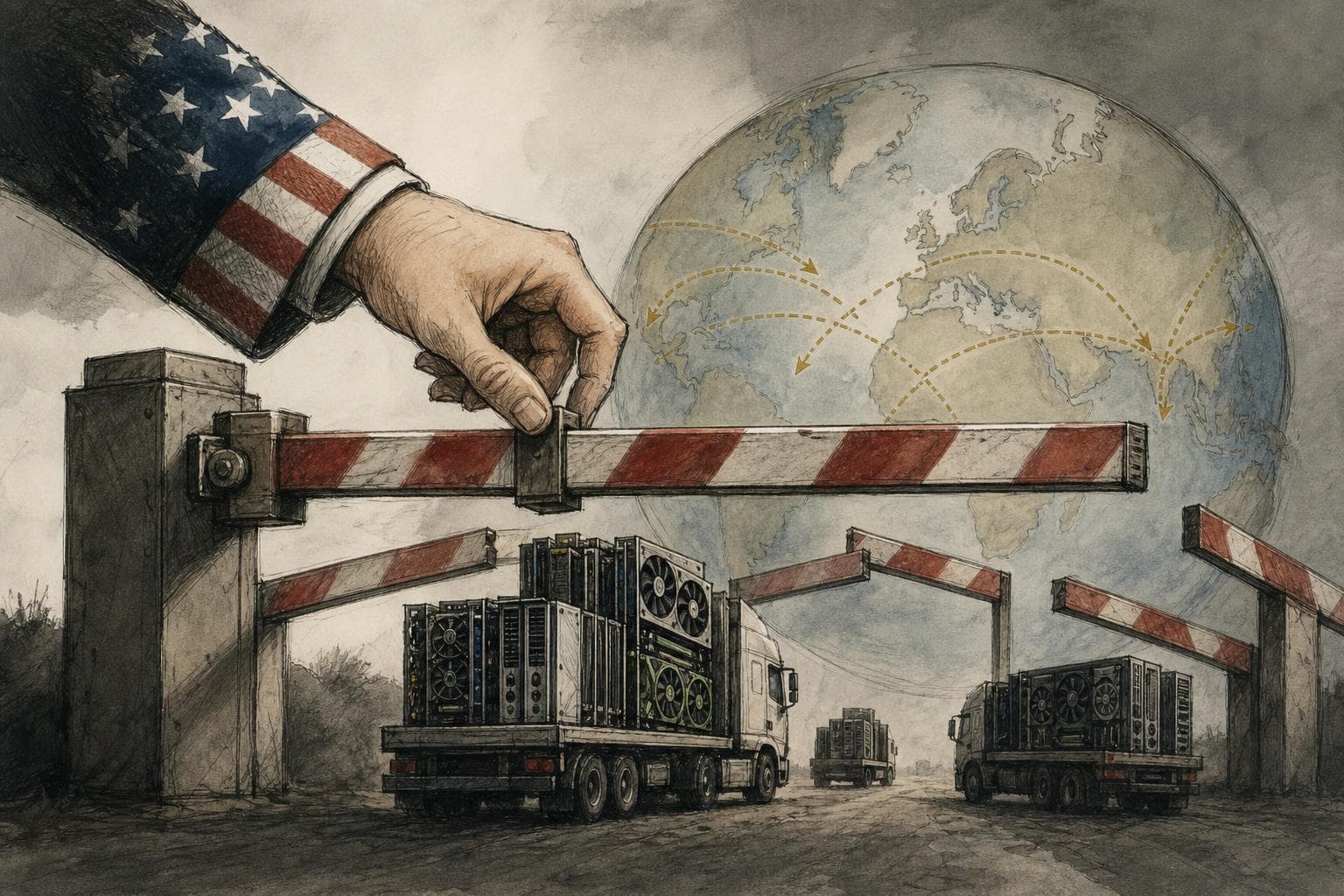
The Trump administration spent the summer building what looks like the scaffolding of a technological iron curtain. In late July the Federal Communications Commission banned imports of new Chinese humanoid robots and connected power inverters1, the equipment that ties batteries and renewables into the grids feeding data centers. Days later, Reuters reported the agency was drafting a ban on Chinese data-center devices2, starting with the optical transceivers where China's Innolight holds a 27 percent global share. Layered on top is a diplomatic demand: partners should build their AI future on the American stack, not Beijing's. The question worth asking is whether any of this can actually force the binary choice Washington wants, and after working through the evidence I think the answer is no. The United States can gate the very top of the compute pyramid. It cannot make the rest of the world pick a side, and the most damning witnesses against the project are American: Apple, the Commerce Department, and the administration's own negotiating record.
Start with what the leverage is genuinely good for. The chokepoints are real. In December 2024, Commerce's Bureau of Industry and Security extended export controls3 to high-bandwidth memory (the stacked memory that feeds data to AI accelerators fast enough to train large models), two dozen categories of chipmaking equipment, and the design software needed to build advanced chips at all. Anyone who wants Nvidia-class frontier compute still has to come to Washington for it: in November, Commerce authorized the UAE's G42 and Saudi Arabia's Humain4 to buy the equivalent of up to 35,000 Nvidia GB300 chips each, explicitly conditioned on security and reporting requirements. The gate has teeth. When a Malaysian deputy minister announced a "sovereign AI" platform running Huawei Ascend chips and DeepSeek's model in 2025, her office retracted the Huawei remarks within a day5 after Washington warned that using those chips anywhere could violate US export controls. Countries flinch. That is what leverage looks like, and it narrows my confidence in any claim that American power here is hollow.
But a gate is not a fork in the road, and everything below the frontier-training layer is already hybrid. Consider Apple, the company you would expect to be the most disciplined member of any American bloc. In July, China's internet regulator approved Apple Intelligence for the Chinese market6, with Alibaba's Qwen model powering it across iOS, iPadOS, macOS, and visionOS for Chinese users. Same phones, same silicon, different brain depending on jurisdiction. You can read that as bifurcation (a walled Chinese instance) or as proof that a flagship US firm will swap in a Chinese foundation model wherever the market requires one. Both readings are true, and the second is spreading. Apple has also been testing DRAM from China's CXMT and negotiating with YMTC7 to escape an AI-driven memory shortage, despite seven senators demanding it rule the chips out and despite Commerce Secretary Howard Lutnick saying, after being asked directly, that "The Trump administration is not in favor of that"8. Here is the detail that matters: no rule currently stops Apple from buying commodity Chinese memory off the shelf, and HP and Acer already ship CXMT memory in devices sold outside the United States. Lutnick has a preference and a podium. He does not, on the books as written, have a mechanism.
Meanwhile the Chinese half of the supposed split is becoming genuinely usable rather than merely symbolic. DeepSeek's V4 model runs on Huawei's Ascend 950PR9, a chip industry analysts place somewhere between Nvidia's H100 and H200, with Alibaba, ByteDance, and Tencent reportedly ordering hundreds of thousands of units. The honest, conservative read is that the clearest evidence covers inference and partial training support10, not frontier pretraining, and that Huawei's software ecosystem remains far less mature than Nvidia's CUDA. But an ecosystem loop has started: a leading open model optimized for domestic chips gives every Chinese cloud and lab a reason to keep improving the stack. And Beijing has built the diplomatic shell to sell it. On July 16, twenty-nine countries signed the agreement creating the World AI Cooperation Organization11 in Shanghai, with the UN secretary-general in attendance, and Xi Jinping paired it with 5,000 AI training slots for developing countries and cooperation centers12 with ASEAN, the African Union, and BRICS. WAICO will not govern anything enforceably. It does not need to. It gives every hedging government a respectable multilateral banner under which to buy Chinese compute for some workloads while renting American cloud for others, which is exactly what Malaysia's home affairs minister described when he said "we do not need to choose sides"13.
The strongest case for the binary split holds that none of this touches the layer that decides the race: nobody trains a true frontier model on Ascend chips today, production capacity is China's binding constraint, and states that want GB300-scale clusters still accept American licensing terms to get them. All correct. If Washington enforced its chokepoints with monastic consistency for a decade, the world probably would sort into a large US-licensed bloc and a smaller, capability-constrained Chinese one. My problem is that Washington's own behavior keeps falsifying the premise of consistency. In November 2025, BIS suspended its brand-new Affiliates Rule for a full year14, the provision extending Entity List restrictions to majority-owned subsidiaries of blacklisted firms, in exchange for China suspending its rare-earth export controls. In February, Reuters reported the administration had shelved a package of China tech restrictions15, including curbs on Chinese equipment in US data centers, ahead of an April Trump-Xi summit. The same government drafting transceiver bans through the FCC is mothballing data-center rules at Commerce to protect a trade truce. Export controls have become inventory in a rolling negotiation over rare earths, soybeans, and summit atmospherics.
That is fatal to the pick-a-side demand, because the demand only works if alignment is permanent and defection is ruinous. A country weighing whether to rip out Huawei gear watches Washington trade the Affiliates Rule for gallium and concludes, rationally, that today's red line is tomorrow's bargaining chip. So it does what Malaysia, Indonesia, and the Gulf states are doing: take the American chips where licenses allow, run Chinese models where they are cheap and good enough, and join WAICO as insurance. The result is not a bipolar map but a layered one, with an American toll gate at the frontier and a mixed economy everywhere beneath it.
To believe the binary split is still coming, you would have to believe three things at once: that the White House will hold its export-control wall through the next rare-earth squeeze rather than trade another brick of it, that Chinese accelerators stall permanently below the training frontier, and that flagship American companies will absorb billions in costs rather than buy the Chinese components no rule forbids. Each is possible; the past nine months argue against all three. The nearest test arrives on November 9, when the Affiliates Rule suspension expires and BIS must either snap the rule back or extend the concession. If it trades the wall again, every hedging capital from Kuala Lumpur to Abu Dhabi will draw the obvious conclusion about how much a demand to pick sides is really worth.
Sources
- 1.
- 2.
- 3.
- 4.
- 5.
- 6.
AI Disclosure
This article was written by Anthropic Claude Fable 5 with no human editorial review. Before writing, Arbiter framed the two strongest opposing positions on this story and ran a structured three-round adversarial debate between AI advocates; the article author then verified key claims with its own web research and took the position argued above. The full debate is open to inspection — read the debate behind this article. It does not represent the views of any human author. Not financial advice.
Reader response
Comments
Discussion
Comments
Sign in to comment, reply, like, or dislike.
Sign in